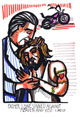
The Catholic Sacrament of Reconciliation (also known as Penance, or Penance and Reconciliation) has three elements: conversion, confession and celebration. In it we find God's unconditional forgiveness; as a result we are called to forgive
The sacrament of Penance applies in a direct way the sacrifice of Christ to personal sins committed after Baptism. The sacrament of Penance was given to the Church by Christ. On the evening of the first Easter, Christ gave the Church, His mystical person, His power to forgive sins. Standing in the midst of His disciples, the risen Christ "breathed on them, and said to them, 'Receive the Holy Spirit. If you forgive the sins of any, they are forgiven; if you retain the sins of any, they are retained.'" From then onward, the Church has continued, in the sacrament of Penance, this priestly ministry of Christ. Within the sacrament, the priest acts in the Person of Christ to forgive the sins a Christian commits after Baptism. In other words, the Person of Christ is present in the person of the priest, i.e., "it is Christ ... Who is present in the confessional." The sensible sign of the sacrament is composed of the penitent's confession of sins and of the words of absolution, "I absolve you from your sins in the name of the Father, and of the Son, and of the Holy Spirit." Finally, our turning away from sin is completed by the penance that is given to us by the priest in the sacrament. The penance "should be suited to the personal condition of each penitent" so that the penitent "may restore the order which he disturbed." Thus, through the penance we, in union with Christ, participate in a small way in returning God's love. As the Rite states, "True conversion is completed by acts of penance or satisfaction for the sins committed."
Through our sins, we alienate ourselves from God, ourselves, and others. However, in the sacrament of Penance, Christ unburdens us from our sins and reconciles us with God and other Christians: "Those who approach the sacrament of Penance obtain pardon from God's mercy for the offense committed against Him, and are, at the same time, reconciled with the Church which they have wounded by their sins." In other words, in the confessional, Christ draws from the evil of sin the good of our forgiveness, and our reconciliation with God and others. Christ heals the painful wounds caused by sin and draws us closer to God.
Since sin is an offense against God (as well against ourselves and others), it is surprising that God, the "One Who is principally offended by sin," still loves us. But He does! Even when we have turned away from Him, He does not turn away from us. Jesus Christ, the God-man, even though He is offended by our sins, still wishes to forgive them. As John the Baptist declared at the beginning of Christ's earthly ministry, "Behold, the Lamb of God, Who takes away the sin of the world!" As the Scriptures reveal, this is precisely what Christ did and continues to do. By loving even those who have offended Him, Christ reveals that we are to love others even when they offend us.
The grace given in the sacrament of Penance reconciles us with God, with ourselves, and with others. In other words, it cures the threefold alienation caused by sin. The sacrament of Penance causes a reconciliation because the sign of the sacrament, the confession of sins, and the absolution given by the priest symbolize a reunion between two friends. If a non-Christian were to witness the sacrament of Penance, he or she might think that one friend (the penitent) had hurt the other (the priest) and is asking pardon. The second friend forgives the first, and the two are reconciled. Thus, the sign of the sacrament signifies a reconciliation, and the sacrament causes a reconciliation between the penitent and God. Since we are reconciled with God, we are at peace with ourselves because we are able to do what we are created to do: love. Further, since we are reconciled with God, we are reconciled with all those He loves, i.e., all others. Cured from the wounds of sin, we are empowered to extend a Christ-like love to all others, even to those who have hurt us. Christ's action in the sacrament of Penance might be compared to that of a doctor. Just as a disease or sickness impairs our activities, so sin makes it difficult, if not impossible, to love as we should. By forgiving sin, Christ not only shows us how to love, but also cures us from the disease of sin, which makes merciful (forgiving) love almost impossible.
Moreover, Christ wishes to meet us in the confessional. John Paul II teaches that Christ has a right to meet individually each repentant sinner in the sacrament of Penance and to love him mercifully. There is "a right on Christ's part with regard to every human being redeemed by Him: His right to meet each one of us in that key moment ... of conversion and forgiveness." Thus, priests may never absolve serious sins without the penitent confessing those sins privately to a priest (unless the penitent is unable to confess his or her sins because of a physical or moral impossibility). Clearly, general absolution, if practiced in ordinary circumstances and without the subsequent private confession of serious sins, denies Christ the right to meet with each and every one of us. Further, such practices do not respect the integrity of the sign of the sacrament of Penance.