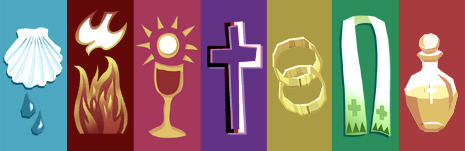
The Latin word sacramentum means "a sign of the sacred." The seven sacraments are ceremonies that point to what is sacred, significant and important for Christians. They are special occasions for experiencing God's saving presence. That's what theologians mean when they say that sacraments are at the same time signs and instruments of God's grace.
If you learn more about the sacraments, you can celebrate them more fully. To learn more about the individual sacraments, please follow the links below. You'll find easy-to-understand articles and a good sample of common questions and answers.
In the practice of the Catholic Church, there are seven sacraments: Baptism, Eucharist, Confirmation, Reconciliciation, Matrimony, Holy Orders, and Anointing of the Sick. A sacrament is an outward sign instituted by Christ in which we meet Him and He confers His divine life, sanctifying grace upon us.
The outward sign of a sacrament is always composed of some matter (some "stuff "), e.g., the water in Baptism, and some words which are said by the one conferring the sacrament. All the sacraments were given to us by Christ, e.g., Baptism as his own Baptism in the Jordan River, and when He gave His final testimony saying to the Apostles, "Go, baptize all nations in the name of the Father, and of the Son and of the Holy Spirit. In the sacraments we meet Christ because He is the cause of the sacraments. He has promised the Church that when these seven signs are done, He will confer his grace upon us. The grace given is tailored to the individual receiving the sacrament according to the different purpose of each sacrament.
In most of the sacraments, the ordinary minister of the sacrament is the priest,e.g., Reconciliation, the Eucharist, Anointing of the Sick. (Of course, if a priest is capable of celebrating a sacrament, so is a bishop because a bishop is also a priest.) A deacon may baptize as well as a priest. Confirmation is usually conferred by a bishop and a bishop always celebrates Holy Orders. Marriage is conferred by the bride and goom on one another. Marriage is the only sacrament where the ones receiving the sacrament are also those who confer it.
Except for the Eucharist, sacraments cause what they signify. For example, to someone walking into Church at the time of a Baptism of a child (who had never seen or heard of Baptism), it would appear that the child was being washed. The external washing with the words "I baptize" (Baptism means a cleansing or washing) appears to be an external washing of the forehead, but through the power of Christ (because we meet Him in this sacrament) the outward sign of washing actually causes a washing of the soul.
The Eucharist does not merely cause what it signifies, but it actualy IS what it signifies becasue of the effect of the outward sign occurs in the bread and the wine--visible to everyone. The "stuff" of the outward sign becomes what it signifies. For this reason and others, the Eucharist is the greatest of the sacraments.
The Greek word for sacrament meant mystery and they are mysteries because they are accomplished through the superntural power of Chirst. Sacraments are radically different than other signs used by the Church, e.g., holy water. One of the uses of holy water is that people make the sign of the cross with the holy water as they enter Church. The water signifies their Baptism and the sign of the cross signifies their belief in their salvation through Christ's Passion, Death, and Resurrection. But the holy water does not cause the person to accept his or her Baptism, nor does it cause them to believe in their salvation. The holy water and the sign of cross merely stand for what the person already has accepted. Holy water and other such signs are called sacramentals to distinguish them from the seven sacraments.
The sacramentals involve our owne efforts because we acknowledge what they are the sign of BEFORE we receive them. The seven sacraments cause (or in the case of the Eucharist, is) what they signify. The difference might be compared to someone pouring water over his or her had to wash. The water is poured by the individual. A sacrament is like a shower where the water washes us without us doing much of anything.